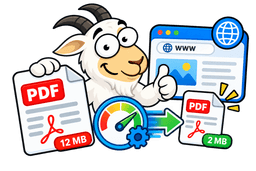
Web optimize PDF
Optimize your PDF's internal structure for faster loading in browsers and viewers.
- Free
- Private
- No limits
- No upload
... or drop file here
Files never leave your device
Add a PDF file to optimize.
Frequently asked questions
What does 'web optimizing' a PDF do?
It rebuilds the file's internal structure — reorganizing objects and enabling linearization — so viewers and browsers can start displaying it before the whole file has downloaded.
Will this make my PDF smaller?
Often yes, since redundant internal objects get cleaned up, but the main goal is faster loading, not maximum compression.
Is the visual content of my PDF changed?
No, pages, text and images look exactly the same — only the file's internal structure is optimized.
Is my file uploaded to a server?
No, optimization runs entirely in your browser.
What if my PDF is already optimized?
You'll see 'Already as compact as it can get' — there was nothing further to restructure.
How is this different from Compress PDF?
Web optimise is a single conservative pass: it rebuilds the file structure and reduces images gently, aiming for a smaller document nobody can tell has been processed. Compress PDF gives you resolution, quality and greyscale controls and will go as far as you ask. Use this one for general web and email use, and that one when you have a specific size limit to hit.
Does it produce a linearised, fast-web-view PDF?
No. True linearisation needs a native linearizer that isn't available in a browser tab, so this tool does the object stream compression, revision cleanup and image reduction but not the page reordering. On modern connections a smaller file helps far more than linearisation does; if you specifically need it, Ghostscript or Acrobat will do it.
Will my text stay searchable?
Yes. Text, embedded fonts and vector graphics are not touched at all — only images are re-encoded and the file structure rewritten. The document remains fully searchable, selectable and accessible to screen readers, and prints exactly as sharply as before.
My file hardly got smaller. Is something wrong?
Probably not. A document that was generated cleanly and is mostly text simply has little to remove: no revision history, no bloated object table, no oversized images. The biggest gains come from files that have been edited and re-saved repeatedly or that carry photographs at camera resolution.
Does optimising remove hidden data from my PDF?
It removes accumulated revision history, which is a real benefit — PDFs saved incrementally keep their earlier states appended, so content deleted in a previous edit can still be sitting in the file. Rewriting the document from its current state drops that. It is not a substitute for proper redaction of content still on the page.
Web optimising is compression aimed at a specific destination: a document that will be opened in a browser, attached to an email, or downloaded over a connection you don't control. It makes two kinds of change — it restructures the file itself, and it reduces images far more gently than the general-purpose compressor does.
The restructuring is the part that has no downside. PDFs accumulate overhead: object tables that grew as the file was edited, revision history from incremental saves, uncompressed cross-reference data. Rewriting the document with its objects packed into compressed streams removes that overhead without touching a single pixel or glyph.
The image handling is where it differs from Compress PDF. That tool asks you to pick a resolution and quality and will go as far as you tell it. This one keeps images generously sized on purpose, aiming for a document that is meaningfully smaller and still looks right on a high-density screen. When you need the smallest possible file and are prepared to trade quality for it, Compress PDF is the tool that lets you.
How to optimise a PDF for the web
Add the PDF
Drop it in or choose it. The current file size is shown so you have a baseline to compare against.
Run the optimisation
The document is rebuilt with compressed object streams and its images are re-encoded at web-appropriate sizes. Text, fonts and vector artwork are left alone.
Check the result
The new size is reported against the original. A text-heavy document may barely change; an image-heavy one usually drops substantially.
Download
The optimised file is offered as a download. Your original is untouched, so you can always go back to it.
What gets changed
- File structure
- The document is rewritten with its internal objects packed into compressed streams rather than listed individually. On a file that has been edited and re-saved several times this alone can remove a noticeable fraction of the bytes, and it costs nothing in quality because no page content is involved.
- Accumulated revisions
- PDFs saved incrementally keep their previous states appended to the file. Rewriting the document from its current state drops that history — which is worth knowing for a second reason: content you deleted in an earlier edit may still have been sitting in the file until now.
- Images
- Re-encoded at resolutions suited to screen display, but deliberately kept generous. The intent is a file that still looks correct on a retina display, not the smallest number achievable.
- Text, fonts and vectors
- Untouched. The document stays fully searchable and selectable, text prints as crisply as before, and vector graphics remain resolution-independent.
Web optimise or compress?
The two tools overlap and are tuned for different answers to "how small does this need to be?"
- Web optimize PDF
- One button, no settings, conservative with quality. Right when the document is going on a website or into an email and should simply be smaller without anyone noticing a difference. Also the better choice for a file that is large for structural reasons rather than because of its images.
- Compress PDF
- Full control over resolution, JPEG quality and greyscale, with the option to flatten pages entirely. Right when there is a hard size limit to meet — an upload form capped at 5 MB — and you are willing to choose what to give up.
What it can't do: true linearisation
"Web optimised" in the PDF specification's sense also means linearised, sometimes called fast web view: the file is laid out so that a browser can display the first page before the rest has downloaded, with a special structure at the front telling the reader where everything is.
That reordering needs a native linearizer, and there isn't one that runs usefully in a browser tab. This tool does everything else — the object stream compression, the revision cleanup, the image reduction — but does not produce a linearised file.
In practice this matters far less than it used to. Modern browsers and connections open a well-compressed 2 MB PDF quickly whether or not it is linearised, and a smaller file helps every reader on every connection, while linearisation only helps the first page of a large one. If you specifically need linearised output, that requires a desktop tool such as Ghostscript or Acrobat.
When the saving is small
A document generated cleanly in one pass from a word processor and consisting mostly of text has very little slack in it. There is no revision history, the object table is already tidy, and there are no oversized images. A small saving or none at all is the honest result rather than a failure.
Files that gain the most are the ones that have been through several rounds of editing, or were produced by tools that write verbosely, or carry photographs at camera resolution. If a large file barely moves and it is full of images, Compress PDF with an explicit DPI will get further.
Information
- Windows
- Linux
- Mac
- iPhone
- Android
How to use Web optimize PDF
Optimize your PDF's internal structure for faster loading in browsers and viewers.
Many tools available
This site offers numerous tools for working with PDFs — merging, splitting, converting, signing, and more.
Easy to use
PDF Goat 24 makes editing PDFs as fast and simple as possible. There's nothing to install or configure — just use the tool right here.
Works on your system
There are no special requirements. This tool works in any modern browser, on Windows, Mac, Linux, and mobile.
No installation required
You don't need to install any software. Everything runs directly in your browser, right where you are.
Security is important to us
Your files are processed entirely in your browser and are never uploaded to a server, so they always stay private.