PDF to XLSX
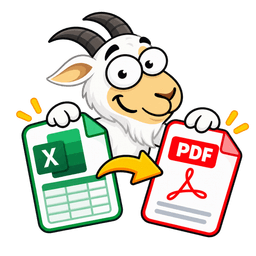
Convert your PDF files to XLSX, right here in your browser.
- Free
- Private
- No limits
- No upload
... or drop files here
Files never leave your device
Add a PDF file to convert.
Frequently asked questions
What is actually inside a XLSX file?
A .xlsx file is not one document but a ZIP archive of XML parts — one for the text, others for styles, images and relationships. Rename it to .zip and you can open it up and look.
Are my files uploaded to a server?
No. Your PDF is read and the XLSX file is built entirely inside your browser, so nothing ever leaves your device.
Can I convert several files at once?
Yes. Add as many PDF files as you like and download the results one by one, or all together as a ZIP archive.
Will the result look exactly like the original PDF?
The text, headings and table columns are recovered and rebuilt as a XLSX file. This is a content-faithful conversion rather than a copy of the original page design, so fonts, spacing and images are not carried over.
What happens with a scanned PDF?
A scanned page is a picture of text rather than text itself, so there is nothing to extract from it. Convert it to an image format instead, or run it through OCR first.
Is there a file size or file count limit?
No. Everything runs on your own device, so the only practical limit is how much memory your browser has available.
Do I need to install anything?
No. There is nothing to install and no account to create — the converter runs in any modern browser, on desktop and mobile alike.
How does it know where my columns are?
By measuring gaps. In normal text a word space is about a quarter of the type size, so a gap approaching the full size of the type is deliberate separation rather than a space — that is where a line gets split into cells. It works on tables with no visible borders too, because the ruled lines are graphics drawn separately from the text and play no part in it.
Does each page become a separate sheet?
Yes, up to fifty. Beyond that, pages are grouped so the workbook stays manageable — a four-hundred-page report becomes fifty sheets rather than four hundred tabs, with a blank row between pages sharing a sheet.
Why are two of my columns in one cell?
The gap between them was too small to distinguish from a word space. Dense tables set in small type do this. There is no threshold to adjust here; the practical workaround is Excel's Text to Columns on the affected column, which will split cleanly if there is a consistent separator.
Why can't I sum my numbers?
Cells are written as text rather than as typed numbers. That is deliberate — deciding whether "1.234" is one thousand or one-point-two-three-four depends on locale conventions, and guessing wrong silently corrupts the data. Select the column in Excel and convert it to numbers, where you can see what you are choosing.
My workbook came out empty.
The PDF has no text layer — it is a scan, a picture of a document. Try selecting a sentence in a PDF viewer: if nothing highlights, there is nothing to extract, and the file needs OCR before any converter can help.
Is my financial data uploaded anywhere?
No. The PDF is read and the .xlsx built inside your browser tab. Since the documents people convert to spreadsheets are overwhelmingly bank statements, invoices and payroll reports, that is the property that matters most about this tool.
Getting a table out of a PDF is the conversion people most often need and the one that most obviously cannot work by simply reading the file. A PDF does not know it has a table in it. It knows where each glyph sits, and the table exists only because a human laid the numbers out in columns and your eye reads the alignment.
So the columns have to be found from the geometry, and the signal is the space between things. In normally set text a word space is roughly a quarter of the type size. A gap approaching a full em — nearly the height of the type itself — is not a word space; it is deliberate separation, which in practice means a column boundary. This converter splits a line wherever the gap between one run and the next exceeds nine tenths of the font size, and those pieces become the cells of a row.
There is a second detail that makes this work at all. pdf.js reports the empty space between two columns as its own whitespace run, as wide as the gap — so a naive reader sees no gap anywhere, because the space is filled with a space. Dropping those blank runs is what leaves a real measurable gap between the runs that matter.
How to convert PDF to Excel
Add your PDF
Drop it in or choose it. Nothing is uploaded — which matters here more than most places, since PDFs converted to spreadsheets are usually bank statements, invoices and financial reports.
Convert
Each page's text is extracted with coordinates, lines are rebuilt from baselines, and each line is split at its column gaps. The result is written as a real .xlsx workbook.
Open it and check the column boundaries
Excel will show one sheet per page. Look down the columns before you use the numbers — gap detection is a measurement, and a tightly set table can put two columns in one cell.
How pages become sheets
Each page of the PDF becomes its own worksheet, named after the page, so a twelve-page statement gives twelve tabs and each one corresponds to something you can find in the original.
That breaks down for very long documents, so there is a limit: beyond fifty pages, pages are grouped so the workbook never exceeds fifty sheets, with a blank row separating the pages that share a tab. A four-hundred-page report becomes fifty sheets of eight pages each rather than four hundred tabs, which no one has ever wanted.
Sheet names are also cleaned to fit Excel's own rules — a maximum of 31 characters, and none of the characters Excel forbids in a tab name — since a workbook Excel refuses to open is not a successful conversion.
Where column detection struggles
- Tightly spaced tables
- If the gap between two columns is smaller than the type size, it looks like a word space and the columns merge into one cell. Dense financial tables set in small type are the usual offenders.
- Wide spacing inside a cell
- The reverse. Text that has been letter-spaced or padded for visual alignment inside a single cell can be split into two.
- Merged and spanning cells
- Not represented. A header spanning three columns is a single run of text and lands in the first cell of its row.
- Ruled lines and borders
- Ignored entirely. The table's visible grid is drawn as vector graphics, quite separately from the text, and plays no part in detection — which is why a table with no visible borders detects exactly as well as one with them.
- Multi-line cells
- Split across rows. A cell whose text wraps onto a second line becomes two rows, because the two lines have different baselines.
- Numbers as text
- Everything is written as text rather than as typed numbers, so a column you want to sum may need converting to numbers in Excel first. Writing them as numbers would mean guessing at thousands separators and decimal conventions, which quietly corrupts data across locales.
Getting a better result
If a specific table matters more than the whole document, extract just those pages first with Extract PDF pages and convert that. Fewer pages means less to check, and a document whose other pages are prose will not dilute the result.
If the columns merge, there is nothing to adjust here — but the same PDF often converts better if you can obtain it from its source in another form. A statement offered as both PDF and CSV should always be taken as CSV.
And if the conversion produces an empty workbook, the PDF is a scan with no text layer. That needs OCR, which is a different operation from anything this tool does.
About the XLSX format
.xlsx is the spreadsheet format Microsoft introduced in 2007. It is published as an open specification under the name ECMA-376 / ISO/IEC 29500, so a file can be read without the program that wrote it.
A .xlsx file is not one document but a ZIP archive of XML parts — one for the text, others for styles, images and relationships. Rename it to .zip and you can open it up and look.
Files like this usually come out of Microsoft Excel, Google Sheets, and LibreOffice Calc.
What comes through
- cell values
- column boundaries
- table rows and columns
- reading order
What does not
- formulas
- cell formatting
- the exact page design
- embedded images
Worth knowing
- Because the format is an open, published one rather than a proprietary blob, a {ext} file can be read by LibreOffice, Google Docs, Apple's iWork apps and this page alike — none of them needs Microsoft Office installed to make sense of it.
- Column boundaries are worked out from where the text actually sits, so a wide table stays a table instead of collapsing into a run of loose words.
- A scanned PDF is a picture of a page, not text, so there is nothing for this tool to extract — the result will be empty. That is the honest outcome, not a failure.
- Spreadsheet cells arrive as the values shown on the page. The formulas behind them are not in the PDF to recover.
Information
- Windows
- Linux
- Mac
- iPhone
- Android
How to use PDF to XLSX
Convert your PDF files to XLSX, right here in your browser.
Many tools available
This site offers numerous tools for working with PDFs — merging, splitting, converting, signing, and more.
Easy to use
PDF Goat 24 makes editing PDFs as fast and simple as possible. There's nothing to install or configure — just use the tool right here.
Works on your system
There are no special requirements. This tool works in any modern browser, on Windows, Mac, Linux, and mobile.
No installation required
You don't need to install any software. Everything runs directly in your browser, right where you are.
Security is important to us
Your files are processed entirely in your browser and are never uploaded to a server, so they always stay private.