PDF Converter
Convert files to PDF and from PDF to other file formats
- Free
- Private
- No limits
- No upload
In which direction do you want to convert files?
Frequently asked questions
Which file types can I convert to PDF?
Word, Excel, PowerPoint, images and several other common file formats can all be converted to PDF.
What can I convert a PDF into?
You can convert a PDF to plain text, HTML, or PNG/JPG images, one file per page.
Are my files uploaded to a server?
No, all conversions run locally in your browser using open-source libraries — your files never leave your device.
Can I convert several files at once?
Yes, add multiple files and download all the results together as a .zip.
Why did a file fail to convert?
It's usually an unsupported file type or a corrupted/password-protected file — check the error message next to that file for details.
Why doesn't my converted Word document look like the PDF?
Because the conversion preserves content rather than design. A PDF stores glyphs at coordinates, not paragraphs, so the structure has to be inferred — text, headings, paragraphs, lists and table columns come across, while exact fonts, spacing and multi-column layouts do not. The result is a document you can genuinely edit, rather than a pile of positioned text boxes that looks closer and breaks the moment you change a word.
I converted a scanned PDF and got an empty file. Why?
Because a scan contains no text — it is a photograph of a page, so there is nothing to extract and an empty result is the correct one. Try selecting a sentence in the original: if nothing highlights, it is a scan. You would need OCR to recognise the characters. PDF to Images or Extract PDF images will give you the pages as pictures instead.
Which direction converts more faithfully?
Into PDF. Going from a structured document to a fixed layout preserves nearly everything, with font substitution the main source of difference. Coming out of a PDF requires inferring structure that was never stored, so it recovers the content reliably and the visual design only approximately.
Are my files uploaded to convert them?
No. Every conversion runs inside your browser tab — PDFs are parsed and written locally, and Office and OpenDocument files are just ZIP archives of XML that are unpacked and rebuilt in the same place. There is no upload, no size limit and no queue.
Why aren't .doc, .xls or .ppt supported?
Those are the legacy binary Office formats, and reading them properly needs a full office suite rather than anything that runs in a browser. Rather than offer a conversion that would quietly mangle the file, they are left out. Re-save them as .docx, .xlsx or .pptx in Word, Excel or PowerPoint and they convert cleanly.
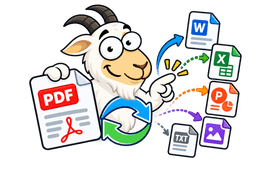
This is the general entry point to every conversion on the site, in both directions: documents, spreadsheets, presentations, images and ebooks into PDF, and PDFs back out into editable and readable formats. Drop a file in and it works out which conversions apply to it.
One thing is worth understanding before you convert anything out of a PDF, because it explains most of the surprises. A PDF does not store paragraphs, tables or headings. It stores glyphs at coordinates — this character, this font, this size, at this point on the page. The structure you see when you read it is something your eye reconstructs, not something written in the file.
So converting a PDF into a Word document means reading the positions back out and inferring the structure: grouping glyphs into lines by their baselines, deciding that anything set larger than the body text is a heading, and splitting a line at wide gaps to recover table columns. That works well, and it is inference rather than retrieval.
How to convert a file
Add your file
Drop in a PDF to convert out of, or a document, image, spreadsheet or presentation to convert into PDF.
Pick the target format
Only the formats that make sense for what you added are offered.
Set any options
Image targets get resolution and quality controls, since those genuinely change the result. Document targets have nothing to configure.
Convert and download
Everything runs in your browser and the result downloads to your device. Nothing is uploaded.
Content-faithful, not pixel-faithful
This is the most important thing to know about converting out of a PDF, and it is a deliberate design choice rather than a limitation to apologise for.
What survives: the text, in reading order, with headings recognised by their size, paragraphs kept intact, tables reconstructed into rows and columns, and lists preserved. Open the result and you have a document you can edit, search and reuse.
What does not: the original page design. Exact fonts, precise spacing, multi-column layouts, floating images, headers and footers, and pixel-level positioning are not reproduced. A visually elaborate brochure converted to Word gives you its words in a sensible order, not a Word file that looks like the brochure.
The alternative would be a document made of text boxes positioned absolutely on the page — which looks closer at first glance and is miserable to edit, because changing one sentence breaks the layout. Producing something editable is the more useful answer, and the honest one.
Scanned PDFs have no text to convert
A scanned document is a photograph of a page. It contains no text at all — no glyphs, no fonts, nothing to read out — so converting it to Word, Excel or plain text correctly produces an empty document.
That is not a failure of the conversion; there was genuinely nothing there. The quick test is to open the PDF and try to select a sentence. If nothing highlights, it is a scan.
Recovering text from a scan needs optical character recognition, which reads the picture and guesses at the characters — a different operation with its own accuracy trade-offs, particularly on handwriting, poor scans and complex layouts. What does work on a scan is PDF to Images, which gives you the pages as pictures, and Extract PDF images, which gives you the original scans at full resolution.
Converting into PDF
This direction is generally more faithful, because it goes from a structured document to a fixed layout rather than the other way round. Word documents, presentations, spreadsheets, OpenDocument files, RTF, Markdown, plain text and EPUB all convert in, along with JPG, PNG, WEBP, SVG and HEIC images.
Fonts are the usual source of difference. A document set in a typeface the conversion doesn't have will be rendered in a substitute, which changes line breaks and can shift pagination. Sticking to common fonts, or converting from the application that created the file where fidelity is critical, avoids it.
Some formats are deliberately not offered, for the same reason the rest of the site avoids overpromising: the legacy binary Office formats (.doc, .ppt, .xls) need a full office suite to read properly, and TIFF has no browser decoder. A tile that produced a poor result would be worse than no tile.
Everything runs in your browser
Both directions are computed locally. PDFs are parsed with pdf.js and written with pdf-lib; Office and OpenDocument files are ZIP archives of XML, which are unpacked and rebuilt in the tab. Nothing is uploaded, so there is no file size limit, no queue, and no copy of your document sitting on a server afterwards.
The practical ceiling is memory. A very large document converted to a very large output holds both in the tab at once, so a phone gives up sooner than a laptop does. Converting in sections is the workaround, and Split PDF is how to make the sections.
The code for a given conversion is only downloaded when you ask for it, so opening this page does not load the machinery for all thirty-odd formats.
Information
- Windows
- Linux
- Mac
- iPhone
- Android
How to use PDF Converter
Convert files to PDF and from PDF to other file formats
Many tools available
This site offers numerous tools for working with PDFs — merging, splitting, converting, signing, and more.
Easy to use
PDF Goat 24 makes editing PDFs as fast and simple as possible. There's nothing to install or configure — just use the tool right here.
Works on your system
There are no special requirements. This tool works in any modern browser, on Windows, Mac, Linux, and mobile.
No installation required
You don't need to install any software. Everything runs directly in your browser, right where you are.
Security is important to us
Your files are processed entirely in your browser and are never uploaded to a server, so they always stay private.