Split PDF
Separate one PDF into multiple files quickly and easily.
- Free
- Private
- No limits
- No upload
... or drop file here
Files never leave your device
Add a PDF file to split.
Frequently asked questions
What does splitting a PDF actually do?
It separates one PDF into several smaller PDFs, based on the page ranges you choose.
Is my file uploaded anywhere?
No, splitting happens locally in your browser — your PDF is never sent to a server.
Can I split a file into more than two parts?
Yes, define as many page ranges as you need; each one becomes its own downloadable PDF.
Does splitting affect the quality of the pages?
No, pages are extracted exactly as they are, with no recompression.
Is there a limit on the number of pages?
No, split documents of any length for free, with no daily limits.
Which split mode should I use for a double-sided scan?
Even and odd. If you fed all the front sides through the scanner and then all the backs, the result is one file with every front followed by every back — splitting on even/odd separates them so you can re-interleave them correctly. Note that it splits by position in the file, not by any page number printed on the paper.
Can I extract just a few specific pages instead of splitting?
Yes, and that is usually the better tool for the job. Extract PDF pages pulls a chosen selection into one new document, and Remove PDF pages deletes a selection from the original. Split is for cutting a document into consecutive runs.
Do the split files keep the original's bookmarks and links?
Annotations and form fields travel with their page, but bookmarks are not rebuilt for the parts, and an internal link whose target page ended up in a different output file will no longer resolve. Both are consequences of those structures belonging to the document rather than to a page.
Why is one of my output files much bigger than the others?
Because size follows content, not page count. A ten-page section of scanned photographs is far heavier than a ten-page section of text, even though both are ten pages. Run the large one through Compress PDF if it needs to come down.
Is there a page limit?
No fixed limit. The constraint is your device's memory, since the source and every output are held in the tab together — and in custom mode, a thumbnail of every page as well. Splitting in two passes is the workaround for documents large enough to struggle.
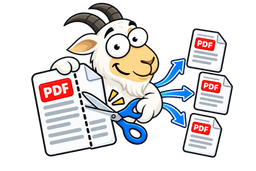
Splitting a PDF means cutting one document into several, each holding a contiguous run of the original's pages. Like merging, it is a copy operation rather than a re-render: the pages that land in each output file are the same page objects that were in the input, with their text, fonts, vectors and images intact. Nothing is rasterised and nothing is recompressed.
There are four ways to decide where the cuts go, and the right one depends on why you are splitting. A 200-page scanned batch of invoices splits cleanly by a fixed page count. A double-sided scan that came out as one file splits by even and odd. A report where the sections start at pages 4, 17 and 40 needs the cut points chosen by hand.
All four run locally in your browser, so the page count and file size don't matter to anyone but your device.
How to split a PDF
Add the PDF
Drop a single file onto the page or pick it with Choose file. The first page is rendered as a thumbnail once it loads, which is a quick check that you have the right document.
Pick a split mode
Choose between a fixed number of pages per file, separating even from odd pages, halving the document, or setting custom cut points yourself. The controls below the selector change to match.
Set the cut points
In custom mode the tool renders every page as a thumbnail and you click the gaps between them to place a scissor mark. Click a mark again to remove it. In pages-per-file mode you just type the number.
Split and download
The output files are generated locally. A single result downloads directly; multiple results are offered together so you can save them in one go.
The four split modes
- Pages per file
- Cuts every N pages. A 50-page document at 10 pages per file gives five documents of ten pages each; if the count doesn't divide evenly the last file simply holds the remainder. This is the mode for batches of same-length documents — scanned forms, invoices, certificates.
- Even and odd
- Produces exactly two files: one with pages 1, 3, 5… and one with 2, 4, 6…. Its main use is repairing a double-sided scan made on a single-sided feeder, where you scanned all the fronts and then all the backs. Note that the numbering is by position in the document, not by any page number printed on the page.
- Halve
- One cut at the midpoint, giving two files. On an odd page count the first half takes the extra page.
- Custom
- You choose every cut. The page grid shows a thumbnail of each page and you place scissor marks in the gaps, so on a 5-page document cutting after pages 2 and 4 yields three files: pages 1-2, 3-4 and 5. Rendering the full grid takes a moment on a long document — it is generated once, the first time you open the mode.
What each output file inherits
Each result is a fresh PDF containing copies of its share of the pages. Text stays selectable, images keep their original resolution, and annotations attached to a page travel with that page.
Document-level structures behave differently, because they belong to the original file rather than to any page. Bookmarks are not reconstructed for the parts — an outline entry pointing to page 60 has no meaning in a file that only has pages 1-20. Form fields are copied with their pages, but a field that logically spanned a section now lives in whichever output that page landed in. Internal links pointing to a page that ended up in a different output file will no longer resolve, which is worth checking on documents with a table of contents.
File size splits roughly in proportion to content, not page count. If one section carries all the photographs, its output file carries most of the bytes.
Encrypted and damaged files
A PDF that demands a password to open cannot be split until it is decrypted — its page objects are encrypted, so there is nothing to copy. Run it through Unlock PDF with the password first. Files that open freely but restrict editing carry only permission flags and split normally.
A file that fails to load at all is usually genuinely malformed rather than merely unusual, often because it was truncated by an interrupted download or an email gateway. Re-downloading the original is the fix; there is no repair step that would not involve guessing at the missing bytes.
Long documents and memory
The source document and all of its outputs are held in the browser tab at once, so a very large file split into many parts is the heaviest thing this tool does. Custom mode adds to that, because it renders a thumbnail of every page.
If a several-hundred-page document struggles, splitting it in two passes is more reliable than one: halve it, then split each half. As with the other tools, the file and your chosen settings are saved to browser storage and the URL carries a session id, so a reload picks up where you left off.
Information
- Windows
- Linux
- Mac
- iPhone
- Android
How to use Split PDF
Separate one PDF into multiple files quickly and easily.
Many tools available
This site offers numerous tools for working with PDFs — merging, splitting, converting, signing, and more.
Easy to use
PDF Goat 24 makes editing PDFs as fast and simple as possible. There's nothing to install or configure — just use the tool right here.
Works on your system
There are no special requirements. This tool works in any modern browser, on Windows, Mac, Linux, and mobile.
No installation required
You don't need to install any software. Everything runs directly in your browser, right where you are.
Security is important to us
Your files are processed entirely in your browser and are never uploaded to a server, so they always stay private.